
Resting Grace Design

Is Overthinking a Sin? What the Bible Actually Says
Updated, March 11, 2026 • 8 minute read
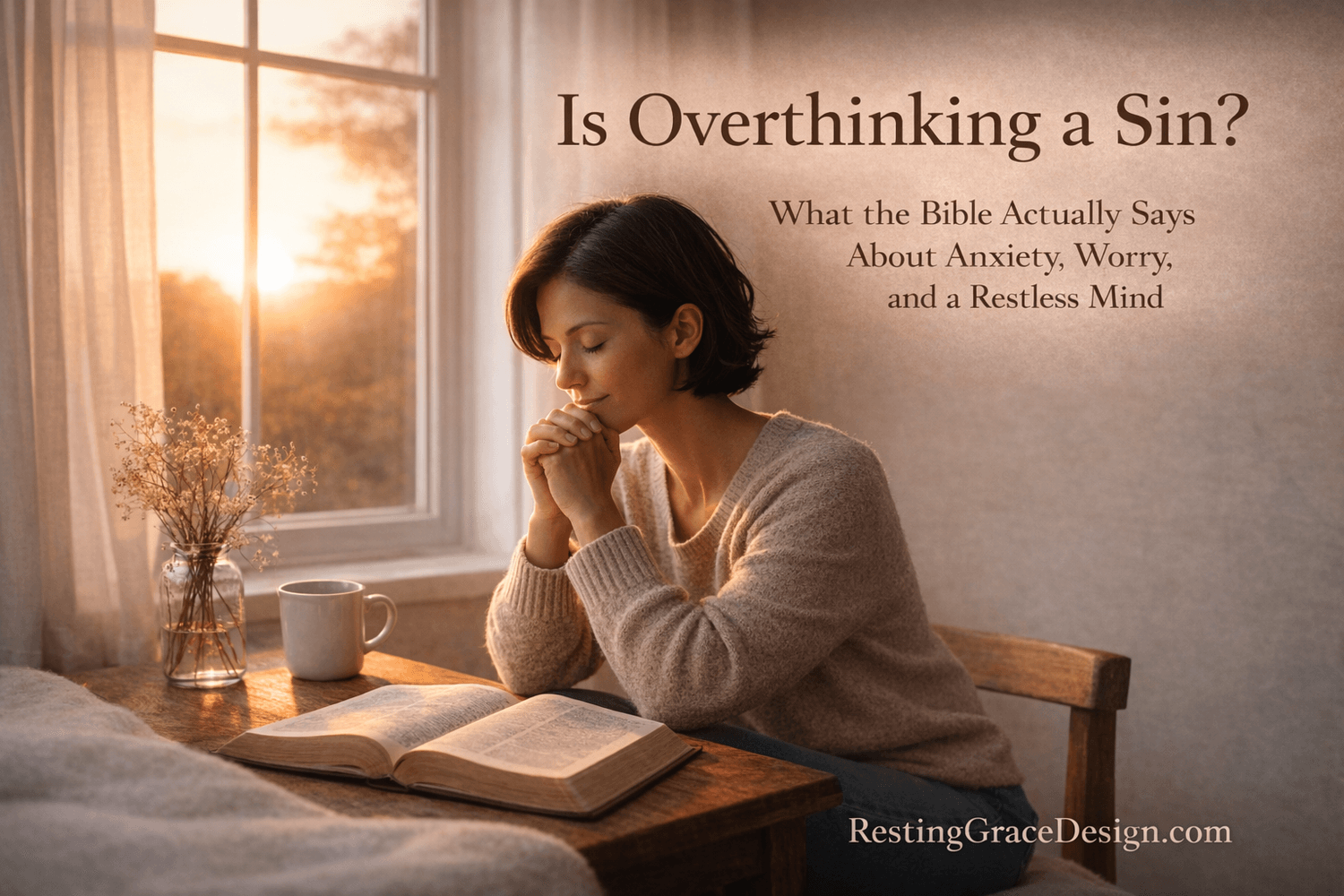
Is overthinking a sin?
No. Having racing or anxious thoughts is not a sin. The Bible does not treat
anxious thoughts as moral failure.
Instead, Scripture invites us to bring our worries to God, who responds with
compassion rather than condemnation. What matters most is not the presence of anxious thoughts, but what we do with them.
What Christians Mean by “Overthinking”
When Christians ask whether overthinking is a sin, they usually mean a pattern of persistent worry or mental spiralling about future problems, decisions, or spiritual concerns. The Bible does not use the word “overthinking,” but it frequently addresses anxiety, worry, and troubled hearts. Scripture’s response is not condemnation but invitation—encouraging believers to bring their anxious thoughts to God and trust His care.
Understanding this difference helps us read biblical passages about worry with clarity and compassion rather than unnecessary guilt.
Introduction
Maybe you recognize this pattern: It's 2:00 a.m., and your mind will not stop. Conversations replay. Worst-case scenarios unfold. You mentally rearrange tomorrow's schedule for the hundredth time. And somewhere beneath the exhaustion, a familiar whisper surfaces: If you trusted God more, you'd be able to sleep.
For many Christians, the struggle with overthinking carries an extra layer of weight—spiritual guilt. We don't just feel mentally exhausted; we feel spiritually defective. We wonder if our racing thoughts mean our faith is weak, if God grows impatient with our repetitive worries, if we're somehow sinning every time our minds spiral. Some believers quietly ask questions like: Is anxiety a sin for Christians? Does the Bible say overthinking is sin? Or even, is worrying a sin according to the Bible? These questions haunt many sincere believers who simply want to honor God with their minds but feel trapped in cycles of anxious thinking.
Perhaps you've heard verses like "do not worry about tomorrow" and interpreted them as divine disappointment aimed directly at you. Maybe you've tried harder to trust God, only to find your thoughts still racing, leaving you convinced that you're failing Him.
Here's what I want you to hear right now, as clearly as I can say it: Your overthinking mind is not a disappointment to God. The thoughts that exhaust you do not exhaust Him. The worries you've brought to Him a hundred times before, He welcomes again tonight. You are not in trouble with God because your mind feels loud.
If this struggle feels familiar, you may also find encouragement in Be Still: When Your Thoughts Feel Loud , a guide for when your mind won't stop racing.
Let's walk through what the Bible actually says about overthinking, worry, and the God who meets us in the middle of our restless thoughts.
Take a moment to pause.
If your mind feels overwhelmed today,
God's invitation is not condemnation,
but compassion.
✦ ✦ ✦
Can Overthinking Be a Sin?
This is the question that keeps many believers awake at night, so let's look at it carefully. To answer well, we need to understand the difference between three very different experiences:
These are the thoughts that simply appear. You don't invite them. You don't choose them. They surface because you're human, because life is uncertain, because you love people and fear losing them, because your brain is wired to anticipate danger. Having these thoughts is not a sin any more than feeling physical pain when you touch something hot is a sin. It's a response, not a choice. This is an important distinction when Christians wonder is anxiety a sin christian—the feeling itself isn't the issue.
This is what happens when anxious thoughts arrive and we get stuck there. We turn them over and over, trying to solve unsolvable problems, searching for certainty we cannot find. This is the experience of overthinking—and for most people, it's not rebellion; it's exhaustion. You're not defiantly refusing to trust God. You're just caught in a mental loop you don't know how to escape.
This is when worry hardens into a settled posture of distrust toward God. It's looking at your circumstances and concluding that God won't come through, that He can't be trusted, that you must take control because He's not reliable. This is the territory the Scriptures address most directly—not the presence of anxious thoughts, but the heart's settled turning away from God.
"Do not worry about tomorrow, for tomorrow will worry about itself. Each day has enough trouble of its own." - Matthew 6:34
When Jesus says, "Do not worry about tomorrow" (Matthew 6:34), He's not scolding people for having anxious feelings. Read that passage again, and notice how gently He reasons with His listeners. He points to the birds of the air and the flowers of the field:
"Your heavenly Father feeds them. Are you not much more valuable than they?" - Matthew 6:26
This is the voice of a patient teacher, not an accuser.
And when Paul writes, "Do not be anxious about anything" (Philippians 4:6), he immediately tells us what to do with our anxiety:
Paul assumes believers will have things that make them anxious. The instruction isn't "stop feeling anxious"—it's "bring those feelings to God."
So can overthinking be a sin? It moves toward sin when it becomes:
"Do not be anxious (worried) about anything, but in every situation, by prayer and petition, with thanksgiving, present your requests to God."- Philippians 4:6
Paul assumes believers will have things that make them anxious. The instruction isn't "stop feeling anxious"—it's "bring those feelings to God."
So can overthinking be a sin? It moves toward sin when it becomes:
A refusal to bring your thoughts to God
A settled belief that He won't handle things well
A pattern of trusting your own anxious calculations more than His promises
But for most believers lying awake at 2:00 a.m., that's not what's happening. You're not rejecting God; you're just tired, and your brain won't stop.
✦ ✦ ✦
Does the Bible Say Overthinking Is Sin?
If you search your Bible for the word "overthinking," you won't find it. The biblical writers didn't use that term. What you'll find instead is something far more comforting: invitation after invitation to bring your anxious heart to God. So when readers ask does the bible say overthinking is sin, the answer requires us to look at what Scripture actually teaches about worry and the anxious mind.
Listen to how Peter frames it:
"Cast all your anxiety on him because he cares for you." - 1 Peter 5:7
This verse doesn't begin with "Stop being anxious." It doesn't say "Anxiety is sin, so repent." It simply tells you what to do with the anxiety you already have—cast it onto God. And notice the reason: because He cares for you.
God doesn't want your anxiety so He can scold you for having it. He wants it because He cares for you, because He doesn't want you carrying weights you weren't meant to bear alone, because He is the kind of God who gathers His children's burdens like a father gathering a tired child into his arms.
The psalmist gives us another window into this:
Did you catch that? The psalmist doesn't say "I confessed my anxiety as sin and God forgave me." He says "When anxiety was great within me, your consolation brought me joy." The anxiety was present. It was real. And God's comfort met him right there in the middle of it.
This is the Bible's consistent pattern: not condemnation for feeling anxious, but compassion for anxious people. Not "how dare you worry," but "come to me, all you who are weary and burdened."
✦ ✦ ✦
🚫What the Bible Does NOT Say About Overthinking
When Christians struggle with racing thoughts, it is easy to assume the Bible is condemning them. Verses about worry are sometimes heard as criticism instead of compassion. But when we look closely at Scripture, we discover that many common fears about overthinking simply are not there.
The Bible does not shame believers for having anxious thoughts. Instead, it consistently invites them to bring those thoughts to God.
The Bible does not say anxious thoughts mean weak faith.
Many sincere Christians quietly wonder if their anxiety proves they lack faith. Yet Scripture shows that faithful people often experienced deep emotional distress. David wrestled with troubled thoughts, Elijah collapsed under fear and exhaustion, and Paul admitted feeling pressure beyond what he could endure.
Their struggles did not disqualify them from God’s love. Instead, their stories show that faith and emotional struggle can exist together.
The Bible does not say God is disappointed when your mind feels overwhelmed.
Some believers imagine that God becomes frustrated when their worries keep returning. But Scripture describes God very differently. He is patient, compassionate, and attentive to the burdens of His people.
“The LORD is compassionate and gracious, slow to anger, abounding in love.” — Psalm 103:8
God does not turn away from anxious hearts. He draws near to them.
The Bible does not say you must silence your thoughts before coming to God.
Sometimes people feel they need to calm their minds before praying, as if God only welcomes peaceful thoughts. But the Bible shows the opposite. The Psalms are filled with honest prayers spoken in moments of fear, confusion, and distress.
God does not require perfect emotional control. He invites honesty.
“Pour out your hearts to him, for God is our refuge.”— Psalm 62:8
You do not need to hide your worries from God. The very thoughts that trouble you are the ones He invites you to bring into His presence.
✦ ✦ ✦
🕊 What Does God Say to Overthinkers?
If you could hear God's voice speaking directly to your racing mind, what would He say? Scripture gives us beautiful answers to that question.
He says: "I am with you."
"So do not fear, for I am with you; do not be dismayed, for I am your God. I will strengthen you and help you; I will uphold you with my righteous right hand." - Isaiah 41:10
This promise wasn't written to people who had perfect faith. It was written to Israel, a nation that constantly struggled to trust God. Yet He declares His presence not as a reward for their faithfulness, but as a foundation for their courage. He is with you—not because you've earned His presence, but because He is that kind of God.
He says: "Cast your burden on Me."
"Cast your cares on the LORD and he will sustain you; he will never let the righteous be shaken." - Psalm 55:22
Imagine actually lifting a heavy weight off your shoulders and placing it onto someone else's. That's the image here. God invites you to do exactly that with your mental burdens. Not because you're strong enough to stop carrying them, but because He's strong enough to carry them with you.
He says: "Come to Me and find rest."
"Come to me, all you who are weary and burdened, and I will give you rest. Take my yoke upon you and learn from me, for I am gentle and humble in heart, and you will find rest for your souls." - Matthew 11:28–30
These are among the most tender words in all of Scripture. Notice who Jesus invites: not those who have their thoughts perfectly under control, not those who've stopped worrying, but the weary and burdened. The exhausted. The overwhelmed.
And notice how He describes Himself: gentle and humble in heart. The One who invites you doesn't approach with impatience or frustration. He is gentle with your struggles, humble in His willingness to meet you where you are.
✦ ✦ ✦
📖 Who in the Bible Struggled With Anxiety?
If you've ever felt alone in your overthinking, the Bible offers a surprising comfort: some of its most faithful figures experienced profound emotional struggles. For anyone wondering who in the bible struggled with anxiety, the answer gives hope.
✦ ✦ ✦
David
The Psalms read like a journal of someone with an active, sometimes tormented mind. David writes:
"How long must I wrestle with my thoughts and day after day have sorrow in my heart?" - Psalm 13:2
David wrestled. He questioned. He brought his raw emotions to God repeatedly. And yet he's described as "a man after God's own heart" (Acts 13:22). Not a man with a perfectly calm mind—a man who kept bringing his turbulent mind to God.
✦ ✦ ✦
Elijah
After his dramatic victory over the prophets of Baal on Mount Carmel, Elijah received a death threat from Jezebel and immediately fled into the wilderness, asking God to take his life (1 Kings 19). The great prophet who had just witnessed fire fall from heaven was now paralyzed by fear and despair.
God's response? He sent an angel with food and water, let Elijah rest, and then spoke to him in a gentle whisper. No rebuke. No "How could you doubt after everything you've seen?" Just tender care and quiet reassurance.
✦ ✦ ✦
Jeremiah
Known as the "weeping prophet," Jeremiah carried such heavy burdens for his people that he wished he could forget his calling (Jeremiah 20:7–9). He expressed deep anguish, confusion, and even accused God of deceiving him. Yet God continued to use him as His spokesperson.
✦ ✦ ✦
Paul
The same apostle who wrote "do not be anxious about anything" also wrote about his own struggles:
"We were under great pressure, far beyond our ability to endure, so that we despaired of life itself." - 2 Corinthians 1:8
Paul knew what it meant to feel crushed, to despair, to carry weight beyond his capacity. He didn't pretend otherwise. He simply learned, through experience, that God remains faithful even in those depths.
These examples matter because they show us that emotional struggle—including anxiety and overthinking—is not evidence of weak faith. It's evidence of being human in a broken world, and it's compatible with being deeply loved by God.
✦ ✦ ✦
How Can Christians Stop Overthinking?
If you've read this far hoping for practical help for your racing mind, here is biblical guidance that addresses both the spiritual and practical dimensions of overthinking. The question how can Christians stop overthinking is one many believers ask, and Scripture offers gentle, realistic paths forward. Let me offer this gently: these aren't formulas that will instantly quiet your thoughts. They're practices that can gradually help you find more space for peace.
🙏 Bring your anxious thoughts to God first.
Before you analyse your thoughts, bring them to God. Before you try to figure out whether they're sinful or faithful, lay them before Him. Prayer is not the last resort after overthinking fails—it's the first response.
"In every situation, by prayer and petition, with thanksgiving, present your requests to God." - Philippians 4:6
The "with thanksgiving" part is important. Thankfulness shifts your focus from what you lack or fear to what God has already provided. It doesn't deny your worries; it places them in a larger context.
🧠 Take thoughts captive—gently.
Paul writes about "taking every thought captive to make it obedient to Christ" (2 Corinthians 10:5). This might sound forceful, but think of it more like gently guiding a wandering child back to safety. When you notice your thoughts spiralling, you can quietly redirect them toward truth.
This isn't about forcefully emptying your mind—that rarely works for overthinkers. It's about gently choosing where to focus. You might repeat a simple Scripture promise. You might thank God for one specific thing. You might ask "What is true right now?" and answer honestly.
📖 Renew your mind through Scripture.
"Do not conform to the pattern of this world, but be transformed by the renewing of your mind." - Romans 12:2
Renewal happens gradually. You don't fix years of overthinking patterns overnight. But as you consistently expose your mind to God's truth, those truths begin to shape your automatic thoughts.
This might mean reading one verse slowly, several times, letting it sink in. It might mean writing Scripture on index cards and placing them where you'll see them. It might mean listening to the Bible while you fall asleep.
🤲 Surrender control—over and over.
Much of overthinking stems from trying to control what we cannot. We think if we can just analyse every angle, we'll prevent disaster or find certainty. But surrender means acknowledging that some things belong to God alone.
"Commit your way to the LORD; trust in him and he will do this." - Psalm 37:5
The word "commit" here literally means to roll onto—like rolling a burden off your back onto someone else's. This isn't a one-time action. You may need to surrender the same concern dozens of times in a single day. That's okay. God's patience is not exhausted by your repetition.
✦ ✦ ✦
Prayer for an Overthinking Mind
Lord Jesus,
You know how tangled my thoughts become. You see how I circle the same worries, searching for answers I cannot find. I bring my weary mind to You—not because I've figured out how to quiet it, but because You've invited me to come just as I am.
Thank You that You are gentle and humble in heart. Thank You that You don't grow impatient with my questions or frustrated with my struggles. Thank You that You've never once said, "Get your thoughts together and then come to Me."
Right now, I roll my burdens onto You. I release the need to figure everything out. I surrender the outcomes I cannot control. I trust that You are good, that You are with me, and that You are working even when I cannot see it.
Teach me to recognize Your voice beneath the noise of my own thoughts. Give me moments of stillness today—brief pauses where I remember that I am held by You.
And on the days when my mind feels loudest, help me to remember that Your love for me does not depend on the quietness of my thoughts. It depends entirely on who You are: my faithful Father, my gentle Savior, my ever-present Help.
Amen.
✦ ✦ ✦
❓ Frequent Asked Question
No, experiencing anxiety is not a sin. Anxiety is a human response to living in a broken world. Scripture never treats the feeling of anxiety as sin; instead, it consistently invites anxious people to bring their concerns to God, who cares for them.
The Bible warns against worry that reflects distrust in God's character or provision, but it speaks with compassion toward those who struggle. Verses like Philippians 4:6 and 1 Peter 5:7 assume believers will experience anxiety and provide guidance for what to do with it, not condemnation for having it.
Many biblical figures experienced deep emotional struggles, including David (Psalm 13:2), Elijah (1 Kings 19), Jeremiah (Lamentations 3), and Paul (2 Corinthians 1:8). Their examples show that emotional struggle and faithful devotion can coexist.
Christians can address overthinking by bringing thoughts to God in prayer, gently taking thoughts captive to redirect them toward truth, renewing their minds through Scripture, and repeatedly surrendering control to God. This is typically a gradual process, not an instant fix.
✦ ✦ ✦
Your racing thoughts do not push God away.
They are often the very reason He invites you closer.
Conclusion
If you take nothing else from this article, please take this: Your overthinking mind does not disappoint God.
He is not surprised by your racing thoughts. He is not frustrated that you're still wrestling with the same concerns. He is not waiting for you to achieve perfect mental stillness before He draws close.
The God who spoke worlds into existence also bends low to hear the anxious whispers of His children. The Saviour who calmed storms with His voice also sits with us in the middle of our internal tempests. The Spirit who empowers also comforts, interceding for us with groans too deep for words.
You are allowed to be honest with God about your thoughts. You are allowed to bring Him the same worry forty times in one day. You are allowed to rest in the truth that your standing with Him depends on His faithfulness, not the quietness of your mind.
And on the days when your thoughts feel loudest, remember the invitation that started all of this: Be still, and know that I am God (Psalm 46:10). Being still isn't about achieving perfect mental silence—it's about remembering, even in the noise, who holds you securely.